Showing posts with label Animator Reviews. Show all posts

Tuesday, 29 March 2011

Bill Plympton review

Bill Plympton

Bio:
Born: 30th April 1946 Portland, Oregon, USA.

1) Bill Plympton

Bill Plympton attended Portland State University in 1964 before transferring to New Yorks School of Visual Arts in 1968. He first became aware of animation at the age of four or five, when he first saw Daffy Duck. He would religiously watch Walt Disney Presents every Sunday night and became a card carrying member of the Mickey Mouse Club. After graduating from college, the animation studio system was almost gone and very little opportunities in animation were available. He spent the next 15 years as a political and gag cartoonist, his work appearing in; The New York Times, Vogue, Rolling Stone, Vanity Fair, Penthouse and National Lampoon. 

After a series of successful shorts, Plympton produced Your Face (1987), an Oscar nominated animation about a man in a chair crooning about the face of his lover. As he sings, his own face begins to distort in various different ways.

2) Your Face

Your Face launched Plympton's animation career and set his signature style of loose, sketchy drawings primarily coloured in pencil. It would also establish a running theme of ordinary, plain characters being exaggerated by the excesses of the things they do, or that happen to them. "Often character designers say because it is a cartoon, you have got to make a character 'goofy'; you have got to give him a big nose and big ears and bulging eyeballs and buck teeth, and I go totally the opposite way; I think that the character should be extremely bland; really normal; sort of non-descript in his characteristics because when something weird happens to him, when he's excited, or when he freaks out, there is a real contrast. And that's the secret of good animation - the movement between something that is sedate to something that is extreme". (Plympton quote. Wells. 2006:45)

This style continued with his other shorts How to Kiss (1989), and 25 Ways to Quit Smoking (1989). Both depicting average people doing normal things with humorous consequences. "Plympton's unique-style, in which he sees the sense of the ridiculous in everyday life...". "His animations are all done by hand, and he uses only four to six drawings per second, less than a Saturday-morning series. Disney style animation requires 12 to 24 drawings per second." (Beck 2004:278).


3) 25 Ways to Quit Smoking

4) How to Kiss


In 1992, Plympton almost single handedly animated his first feature The Tune. The feature follows Del, a songwriter desperately trying to finish a song and deliver it to his unpleasant boss Mr. Mega. On the way to his office, Del gets lost and winds up in Flooby Nooby, along the way meeting a wiseman, and Elvis impersonating dog and a noseless cab driver. "If the basic story of "The Tune" is almost too simple to bother relating, Mr. Plympton, one of the country's most admired creators of animated shorts, has fleshed it out with a continually inventive and witty series of tangents. Animated with 30,000 ink and watercolor drawings, the movie effuses a jaunty surrealistic magic of a sort that the folks at Disney, with all their resources, have probably never even thought of." (Holden 1992.)

5) The Tune

Plympton continues to animate over a range of media, lending his unique style to Kanye Wests' music video "Heard 'Em Say" (2005) and "Weird Al" Yankovic's "Don't Download this Song" (2006), as well as shorts and feature length animations.

Raymond Brigg's review

Raymond Brigg's

Bio:
Born: 18th January 1934 Wimbledon, London, England.
Birth name: Raymond Redvers Briggs

1) Raymond Briggs

Born to working class parents, Ethel and Ernest, Raymond Briggs studied painting at the Wimbledon School of Arts and typography at the Central School of Art. After completing two years of National Service, he returned to further his studies with the Slade School of fine art, graduating in 1957. He became a professional  illustrator and began to become popular from various cartoon strips and comics. 

In 1982 Channel 4 was launched and Paul Madden was appointed as animation consultant. Their decision to commission programs from outside deemed more profitable than making their own. One of their first productions was an adaptation of Raymond Briggs' The Snowman (1982), where a young boy and his beloved snowman fly to the north pole to meet Father Christmas. Staying true to his wordless story, "The animators who worked on The Snowman retained the soft crayoned look of Raymond Briggs' original illustrations. It was nominated for an Oscar and won the BAFTA for best children's film 1983. It has become one of the studio's best-loved films." (Beck. 2004:282.) One that has been repeated for every subsequent Christmas.

2) The Snowman

The success of The Snowman meant Paul Maddon could finance other young animators, including the Quay brothers. Briggs' next involvement would be the poignant tale of Jim and Hilda Bloggs, middle class senior citizens trying to avoid nuclear fallout in "When the Wind Blows" (1986).  "James and Hilda Bloggs are a most unlikely hero and heroine, and ''When the Wind Blows'' is a most unlikely entertainment. Here is an animated film (with live-action inserts) about the end of civilization, a subject much beloved by the makers of dreary, numbingly arty cartoons shown at film festivals." (Canvy. 1988).

3) When the Wind Blows
Briggs continued to produce books and teach illustration at the Brighton School of art until 1986. In 1991 he introduced a grumpy Santa in Father Christmas and later was recognized in 1993 by achieving the Childrens Author of the Year by the British Book Awards. He resides in Westmeston, Sussex and continues to write and illustrate books.

Bibliography

Beck, Jerry (2004). Animation Art From Pencil to pixel, the histroy of Cartoon, Anime and CGI. London, Flame Tree Publishing.

Canby, Vincent. New York Times review When the Wind Blows 11th March 1988
http://movies.nytimes.com/movie/review?res=940DEFDC103FF932A25750C0A96E948260 Accessed 29/03/11

Illustrations

1) Raymond Briggs picture http://static.guim.co.uk/sys-images/BOOKS/Pix/pictures/2010/12/1/1291199607475/Raymond-Briggs-and-Father-005.jpg Accessed 29/03/11

2) The Snowman http://www.manchestereventsguide.co.uk/img/full/pop/snowman%20front.jpg Accessed 29/03/11

3) When the Wind Blows http://flickfeast.co.uk/wp-content/uploads/2010/05/when-the-wind.jpg Accessed 29/03/11

Monday, 28 March 2011

The Quay Brothers review

The Quay Brothers

Bio:
Born: 17th June 1947 Norristown, Pennsylvania

1) Stephen and Timothy Quay

Twin borther's Stephen and Timothy Quay initially studied illustration at the Philadelphia College of Art before moving to London to take a course at the Royal College of Art (RCA).  They began experimenting with animation, creating their first short Nocturna Artificilia (1979). Shortly after Nocturna they established their studio Koninck with their friend and collaborator Keith Griffiths who they met at the RCA. Nocturna Artificilia depicts a man staring from a window, mesmerized by a trolley car passing through a city at night. He is then seen back in his room, abruptly woken falling from his chair. The film would become a blueprint of subsequent films: sets dominated by darkness; bizarre, unexplained nightmarish happenings all filmed with odd camera angles.

2) Nocturna Artificilia

The Quays work is heavily influenced by Eastern European Cinema, rekindling the Gothic screenplays of the 1930's,  particularly the work of Jan Svankmajer. Holding Svankmajer in high regard they paid homage to him with a documentary The Cabinet of Jan Svankmajer - Prague's Alchemist of Film (1984). They went onto to produce perhaps their most famous work Street of Crocodiles (1986) based on a story by Bruno Schulz and financed by the British Film Institute (BFI). It follows an elderly museum watchman who's saliva drops on a kinescope machine, bringing it to life and in turn a puppet that severs its strings and investigates the Street of Crocodiles. The puppet explores gothic rooms through eerie doors leading to a sweatshop where he is taken apart, redesigned and reclothed. "The world invented by the Quay brothers for Crocodiles was the colour of an old photograph; sepia, dirty, dark yellow, and brown. It seemed as if it was a locked room or glass cabinet that nobody had opened for years - dusty and cobwebby, almost a mystical land." (Beck. 2004:285).

3) Street of Crocodiles

The twins' miniature sets and backgrounds are as carefully considered as the characters they portray. "We ask our machines and objects to act as much if not more than the puppets." (Faber / Walters. 2004:76). The skills they acquired in building miniature scenes were transferred to designing theater and opera sets for which they were nominated for a Tony Award. On the lighter side they broadened their skills to music videos and pop promo's, most notably animating objects in Peter Gabriel's Sledgehammer video in 1986

4) Peter Gabriel - Sledgehammer

The brothers moved into live-action, feature length film Directing The Institute Benjamenta (1995) before returning to animation with the award winning In Absentia (2000). The film takes the viewer inside the mind of a patient in an asylum who compulsively writes letters to her absent husband. Collaborating with avant-garde composer Karlheinz Stockhausen, the brothers attempted to capture the essence psychosis through hazy, diffused light and it's reflections on surfaces. "This is brilliantly achieved, creating one of their most unusual and singularly disturbing films not through any conventional imagery, but through the lighting and the subliminal tension evoked through tensed blackened graphite-dusted fingers gripping pencils and hands grasping at the woman’s neck. It’s assisted considerably in this respect by the almost demonic soundscape created by Stockhausen." (Megahey. 2006).

5) In Absentia


Bibliography

Beck, Jerry (2004). Animation Art From Pencil to pixel, the histroy of Cartoon, Anime and CGI. London, Flame Tree Publishing.

Faber, Liz and Walters, Helen. (2004) Animation Unlimited, Innovative Short films since 1940. London, Laurence King Publishing Ltd.

Megahey, Noel. (2006) Digital Fix online DVD review The Quay Brothers: The Short Films 1979 - 2003
http://homecinema.thedigitalfix.co.uk/content.php?contentid=63327 Accessed 26/03/11

Illustrations

1) Stephen and Timothy Quay http://gordonandthewhale.com/wp-content/uploads/2010/02/QuayBrothers-450x339.jpg Accessed 26/03/11

2) Nocturnia Artificialia http://mmimageslarge.moviemail-online.co.uk/18424_QuayBrothers-6.JPG Accessed 26/03/11

3) Street of Crocodiles http://www.google.co.uk/imgres?imgurl=http://verdoux.files.wordpress.com/2009/06/street-of-crocodiles-1.jpg Accessed 26/03/11

4) Peter Gabriel - Sledgehammer music video still - http://www.videoville.org/wiki/images/thumb/4/44/Petergabriel_sledgehammer1.jpg/400px-Petergabriel_sledgehammer1.jpg Accessed 26/03/11

5) In Absentia http://www.dvdtimes.co.uk/protectedimage.php?image=NoelMegahey/quaybrothers3.jpg Accessed 26/03/11


Thursday, 24 March 2011

Jan Svankmajer review

Jan Svankmajer

Bio:
Born: 4th September 1934 Prague, Czechoslovakia

1) Jan Svankmajer

Jan Svankmajer is an influential surrealist animator, artist and filmmaker from Prague, Czechoslovakia. He was first introduced to animation when he was given a puppet theatre for Christmas 1942. Studying at DAMU (Prague Academy for performing Arts), he specialized in puppetry, direction and set design. Here he gained a particular interest in Soviet avant-garde theatre and film. "Meyerhold and Tairov were my heroes, together with (Sergei) Eisenstein and (Dziga) Vertov." (Svankmajer quote. Walters/Faber. 2004:100). Svankmajer's graduation film used a combination of puppets, live actors and actors dressed as puppets, a technique he would later use in his film The Last Trick, (1964).

2) The Last Trick

In 1960, Svankmajer founded the Theatre of Masks and during it's first production, met his future wife Eva, an internationally respected surrealist painter. A pivotal encounter in his life, Svankmajer himself became an official member of the Czech Surrealist group in 1970. However, following the release of his 1972 film Leonardo's Diary, Svankmajer was banned from making films for seven years for featuring unauthorized portrayals of everyday life in Czechoslovakia. 

3) Leonardo's Diary

Svankmajer continued to draw, paint, sculpt and write in his seven year hiatus, working as a special-effects designer at the Barrandov Film Studio creating title sequences for various films. Permitted to make films in 1979, he ran into trouble with again with his multi award winning short Dimensions of a Dialogue (1982). The short comprises of three segments: "Exhaustive Discussion" depicts heads made from inanimate objects devouring each other to bland copies. "Passionate Discourse" shows a clay man and women dissolving into one another sexually, reducing to a boiling pulp. "Factual Conversation" portrays two clay men head's, extruding toothbrushes, shoelaces and other objects from their tongues, intertwining them into various other combinations. The film was banned in Czechoslovakia and shown to the Central Committee Communist Party as an example of the kind of film that should not be made.

4) Dimensions of a Dialogue: Exhaustive Discussion

5) Dimensions of a Dialogue: Passionate Discourse

6) Dimensions of a Dialogue: Factual Conversation

Svankmajer continues to produce short and feature length films as well as pop videos. He founded the Athanor film studio in 1991 and was awarded the lifetime achievement award at the World Film Festival of Animated films in Zagreb, Croatia in 2000. His adopted conceptual premise to his films and animations produce highly original outcomes. "...his use of surreal images drawn from the unconscious to prompt moments of fear and revelation in his audience - are conceptual applications to the medium and should be understood as a methodology in the creation of distinctive imagery and alternative narratives." (Wells. 2006:102).

Throughout his career, Svankmajer has mastered a range of media using surrealism to put a unique spin on his films. His work has had a huge influence over many artists, animators and film makers including the Brothers Quay, Tim Burton and Terry Gilliam. "Although certainly not the only experimental or even surrealist filmmaker working in animation, Å vankmajer’s take on surrealism is quite a unique one, relying on a common and quite easily identifiable set of objects and themes, but drawing on a remarkable range of techniques that include drawing, puppetry, stop-motion animation, claymation, cut-out animation as well as even live-action to explore the objects and the relationship they have with people as thoroughly as possible." (Megahey. 2007.)

Bibliography

Faber, Liz and Walters, Helen. (2004) Animation Unlimited, Innovative Short films since 1940. London, Laurence King Publishing Ltd.

Wells, Paul (2006). The Fundamentals of Animation. Switzerland, AVA Publishing.

Megahey, Noel. 19th June 2007 review of Jan Svankmajer: The complete short films (1964 - 1992)
homecinema.thedigitalfix.co.uk Accessed 24/03/11

Illustrations

1) Jan Svankmajer http://www.jansvankmajer.com/bio.htm Accessed 24/03/11

2) The Last Trick http://www.dvdtimes.co.uk/protectedimage.php%3Fimage%3DNoelMegahey/svk_lasttrick2.jpg Accessed 24/03/11

3) Leonardo's Diary http://img129.imageshack.us/img129/264/bscap0001mo8.jpg Accessed 24/03/11

4) Dimensions of a Dialogue: Exhaustive Discussion http://www.dvdtimes.co.uk/protectedimage.php%3Fimage%3DNoelMegahey/svk_dimensionsofdialogue1.jpg Accessed 24/03/11

5) Dimensios of a Dialogue: Passionate Discourse http://www.dvdtimes.co.uk/protectedimage.php%3Fimage%3DNoelMegahey/svk_dimensionsofdialogue2.jpg Accessed 24/03/11

6) Dimensions of a Dialogue: Factual Conversation
http://www.kratkyfilm.cz/catalogue/images/small/178.jpg Accessed 24/03/11


Monday, 21 March 2011

Ladislaw Starewizc review

Ladislaw Starewicz

Bio:
Born: 6th August 1882 Moscow, Russia
Died: 28th February 1965 Fontenay-sous-Bois, Seine, France

1) Ladislaw Starewicz

Born in Moscow, Russia to Polish parents, Ladislaw Starewicz started his career making documentaries for an ethnographic museum including an animated reconstruction of Stag Beetles nocturnal mating rituals called Battle of the Stag-Beetles (1910). For this feature he used preserved specimens and wax to animate their limbs frame by frame. He would later develop a standard method of making puppets using wooden frames, wire, cork and plaster. One of his early masterpieces, The Cameraman's revenge (1912), a comedy that tells the expressive love affair between Mr and Mrs Beetle.

2) The Camerman's revenge

The history of stop motion animation has derived from two distinct paths. Starewizc was at the forefront of the European initiative. "...European artists' films, typified by the work of Jiri Trnka and Ladislaw Starewicz, and creative programming for children's television, exemplified by Aardman's The Amazing Adventures of Morph (1981)." (Selby. 2009:100). Whereas Hollywood, America used it to create maximum impact on their audience special-effects films. Likewise Starewicz's animal characters were a complete contradiction to America's quirky, loveable animal characters such as Mickey Mouse and Bug's Bunny. "Starewicz's work corresponds to the darker, amoral universe of the European fairy tale, and uses animals as highly conscious, dramatic characters, often with complex motives, again a far cry from the use of animals in the American cartoon tradition." (Wells. 2006:100). Fleeing to France in 1919 following the Russian Revolution, Starewicz's career flourished in the silent era with poetic films such as The Voice of the Nightingale (1923) and Reynard the Fox (1930).

3) Voice of the Nightingale


Starewicz made the transition to sound with his film The Mascot (1933). The story revolves around a stuffed dog who sneaks out to get his sick mistress an orange. Along the way he encounters a range of characterful individuals including fish skeletons and other creatures made from litter and the devil himself. The range of emotions in the puppets is remarkable for it's time and enhanced by the addition of musical sounds for sound effects.

4) The Mascot

Starewizc continued to make films for the remainder of his life in collaboration with his daughter Irene, dying during the making of his last film, Like Dog and Cat (1965). His later films unfortunately failed to replicate the magic of his silent and early sound features. However, his pioneering work progressed stop motion animation on both sides of the Atlantic, inspiring the works of other greats such as Ray Harryhausen. "He holds a place in puppet animation comparable to Winsor McCay's place in drawn animation. With his early films, he essentially established the art of stop-motion animation, taking it beyond the realm of the early French trickfilms." (Beck. 2004:84).

Bibliography

Beck, Jerry (2004). Animation Art From Pencil to pixel, the histroy of Cartoon, Anime and CGI. London, Flame Tree Publishing.

Selby, Andrew (2009). Animation in Process. London, Laurence King Publishing Ltd.

Wells, Paul (2006). The Fundamentals of Animation. Switzerland, AVA Publishing.

Illustrations

1) Ladislaw Starewicz Picture https://blogger.googleusercontent.com/img/b/R29vZ2xl/AVvXsEhfm4DzljJBwTtUP3dxpIXLMqffE3GYmHmWduu7495wwcEAaw-UZ5S3DGwEqif5EdQptYj4hGU60wUt6oimpeIEJR7ktDiw_ksGsWRWBhrEDSNLDOGrQObsOxX6Ml6THtrZB9NCsAwn03en/s1600/ladislaw.jpg Accessed 21/03/11

2) The Cameraman's Revenge http://img.listal.com/image/893426/936full-the-cameraman%27s-revenge-poster.jpg Accessed 21/03/11

3) Voice of the Nightingale http://media.kickstatic.com/kickapps/images/66470/photos/PHOTO_9454518_66470_18660554_main.jpgAccessed 21/03/11

4) The Mascot http://media.kickstatic.com/kickapps/images/66470/photos/PHOTO_9454514_66470_18660554_main.jpgAccessed 21/03/11


Walt Disney review

Walt Disney

Bio
Born: 5th December 1901 Chicago, Illinois, USA
Died: 15th December 1966 Burbank, California, USA

Birth Name: Walter Elias Disney


1)Walt Disney

" "I hope we never lose sight of one thing." Walt Disney would later say. "It all started with a mouse". In truth, however, years before Mickey, the animation pioneer was already producing successful silent cartoons." (Beck. 2004:20). It actually all started with a cat called Julius, a reoccurring character in Disney's "Alice's" cartoon newsreels produced for Frank L. Newmans theater chain in 1921 - 1922. Disney's first company name was called Laugh-O-Gram Studio's and the Alice films proved successful and showed early signs of Disney's pioneering nature, breaking new ground combining animation and live action. "Unlike cartoon fairy tales, the Alice comedies were more innovative, placing youngster Virgina Davis into a cartoon world...." (Beck. 2004:20).

2) Alice Film Poster

Unfortunately for Disney the distributors of the Alice films, Pictorial Clubs Distribution firm, went bankrupt and took Laugh-O-Gram Studio's with it. However, Alice's Wonderland, the final reel made before shutdown secured a deal with Felix the Cat's distributor Margaret Winkler, wife of Charles Mintz. Walt relocated his team and started again in Hollywood. By 1927, the Alice series had run it's course and a new series was created starring Oswald the Lucky Rabbit. Universal Pictures owned the character, Mintz was the producer and Disney the ran the production house. The series was a hit, the team grew and the animation got better and better. In February 1928 Disney went to meet Mintz in New York to negotiate better salaries for his studio and team. Mintz replied that Disney would take a cut in pay, or his top animators would work directly for Mintz producing Oswald's adventures. This turned out to be true, aside from a handful of animators, the majority had agreed to the deal in secret.


3) Oswald the Lucky Rabbit

Disney took the handful of animators loyal to him and decided to create a new character. Where he had lost a rabbit, he gained a mouse. It is rumoured that his wife Lillian named him Mickey instead of Mortimer and that Disney created him on the train home from Mint'z office. Mickey was quickly implemented, staring in Plane Crazy and Gallopin' Gaucho both made in 1928 but without the backing of a major distributor. What finally made the difference was sound. Although he was not the first make an animated feature with sound, he was the first to animate an entire one-reel cartoon story fully sound synchronized.... Steamboat Willie (1928). "With Steamboat Willie (1928), Disney, in the face of increased competition from the technically adept Fleischer Studio, created the first fully-synchronized sound cartoon, simultaneously introducing animation's first cartoon superstar, Mickey Mouse." (Wells. 2006:89).

This was the start of 'the Golden Era' of animation. As Mickey's popularity increased, new characters were created. Donald Duck, Goofy, Minnie Mouse and Mickey's dog Pluto evolved from other short films and gained popularity in their own right. Disney's ambitions extended further than animated shorts. Within ten years of Steamboat Willie, he made Snow White and the Seven Dwarfs (1937), the first fully synchronized, full length cartoon feature. To depict realistic movements of the human characters, Walt helped to pioneer the technique of Rotoscoping. This involved the animators tracing live action footage to contrast the cartoony features of the animals and Dwarfs.

4) Snow White and the Seven Dwarfs

Snow White was an overwhelming success and a landmark in the history of animation and film. Disney's team's expanded. Divided into groups of two, some continued making the animated shorts Silly Symphonies while the rest were charged with creating new features including Pinnochio (1941). Mickey's popularity was beginning to stutter with audiences actually preferring his side kick Donald Duck. In a bid to rejuvenate his popularity, Disney began to work on the Sorcerer's Apprentice, casting Mickey as the hapless apprentice. Disney initially intended it to be a short on the Silly Symphonies series until Orchestral composer Leopold Stokowski persuaded him to make it a full length feature. The idea grew into Fantasia (1940), consisting of eight animated segments (including the Sorcerer's Apprentice), all set to pieces of classical music, featuring; Pyotr Ilyich Tchaikovsky's Nutcracker Suite where the four seasons are depicted by dancing fairies, fish, flowers and leaves; and Modest Mussorgsky's Night on Bald Mountain, a darker segment featuring a devil summoning spirits atop a mountain.

5) Nutcracker Suite

6) Night on Bald Mountain

Fantasia opened to mixed critical reviews and failed to generate a large commercial audience but has since been rated as a top thirty highest grossing films of all time when adjusted for inflation. This success led to a sequel in in 1999 called Fantasia 2000. As before, it featured seven new animated segments set to classical music conducted by James Levine along with a remastered version of the Sorcerer's Apprentice. Like Fantasia, the sequel had mixed reactions with critics, however it does have hints of Disney's style and magic. Stand out segments include Ottorino Respighi's Pines of Rome featuring  a family of humpback whales with the ability to fly, and Dmitri Shostakovich's Piano Concerto No. 2 based on Hans Christian Andersen's The Steadfast Tin Soldier which finds a toy soldier struggling to save a toy ballerina from an evil Jack in the box. ".... the music seems more background than integral to any concept. This is not to say that ''Fantasia/2000'' is devoid of dazzling moments. But despite its science fiction title, the movie is really a compendium of familiar Disney attitudes and styles, one that looks to the past more than to the future." (Holden. 1999)

7) Pines of Rome

8) The Steadfast Tin Soldier

Walt Disney died in 1966 leaving behind a legacy in the form of Disney Land resorts and his animation studios. His pioneering personality ensured cel and drawn animation techniques would go down in the history of world cinema. Disney set himself apart from other experimentalists in animation of the time. Inspired by pioneering companies such as Kellog's and Ford he passionately strived to deliver his product to mass audiences. "... Disney represented someone who saw the power and possibility of animation as a mass-media player and who worked progressively towards this dream." (Selby. 2009:13)

Bibliography

Beck, Jerry (2004). Animation Art From Pencil to pixel, the histroy of Cartoon, Anime and CGI. London, Flame Tree Publishing.

Holden, Stephen December 1999 New York Times Review of Fantasia 2000 Accessed 21/03/11
http://movies.nytimes.com/movie/review?res=9802E0D81538F932A05751C1A96F958260&scp=3&sq=Fantasia&st=cse&pagewanted=print

Selby, Andrew (2009). Animation in Process. London, Laurence King Publishing Ltd.

Wells, Paul (2006). The Fundamentals of Animation. Switzerland, AVA Publishing.

Illustrations

1) Walt Disney http://pubvo.com/wp-content/uploads/2011/01/mickey-mouse.jpg Accessed 21/03/11

2) Alice's Spooky Adventures http://ia.media-imdb.com/images/M/MV5BMTQyOTg2ODQ1MV5BMl5BanBnXkFtZTYwNzczMzk5._V1_.jpg

3) Oswald the Lucky Rabbit http://bulk.destructoid.com/ul/user/2/29336-159693-Oswald1gif-620x.jpg

4) Snow White and the Seven Dwarfs http://www.collider.com/uploads/imageGallery/Top_Ten_Animated_Films/snow_white_and_the_seven_dwarfs_movie_image_1.jpg

5) Nutcracker Suite http://outtheother.typepad.com/.a/6a00d83451aecf69e20120a75d83f4970b-500wi&imgrefurl

6) Night on a Bald Mountain http://trueclassics.files.wordpress.com/2010/08/night-on-bald-mountain-fantasis.jpg

7) Pines of Rome http://dvdmedia.ign.com/media/reviews/image/fantasia/fantasia2k_1.jpg

8) The Steadfast Tin Soldier http://www.biabianca.de/couplepages/BallerinaSoldier/soldier2.jpg


Sunday, 20 March 2011

Norman McLaren Review

Norman McLaren

Bio:
Born: 11th April 1914 Stirling, Scotland
Died: 26th January 1987 Montreal, Canada


1) Norman McLaren

Norman McLaren was a Scottish born, multi award winning Canadian animator. He attended the Glasgow School of Art where he drew inspiration from the films of Fischinger, Cohl and Eisenstein. He was fascinated with motion and realized the potential of film as art form. "I found painting and drawing not satisfying because they didn't have motion and movement in them. I saw film as a means of manipulating motion." (McLaren quote, Beck. 2004:102) After winning a prize at the Glasgow Amateur film festival, McLaren took a position with Britain's General Post Office Film Unit.

His first assignment was to film the Spanish Civil War, he then returned to London to animate two films. Many a Pickle (1938) explored the pixilation technique whereas Love on the Wing (1938) was made by drawing directly on to film. He then emigrated to America and continued to animate short films and joined the National Film Board of Canada in 1941. 

In 1949, McLaren created one of his greatest films, Begone Dull Care, an abstract film with bursts of colour and shapes which multiply and recede to a composition by jazz composer Oscar Peterson. This film established McLaren as an 'alternative method' animator. Alternative in terms of industrial production such as stop motion and the established "Disney" style. Begone Dull Care demonstrated McLaren's ability to use music and sound to enhance his visual style. Andrew Selby explains "...McLaren used the medium (animation) as a way of expressing ideas through sound and image and questioning the conventions surrounding two-dimensional sequential work in the process." "...Mclaren was an accomplished filmmaker but also hugely invested in the influence of music and sound." (Selby. 2009:13).

2) Still from Begone Dull Care

In 1953, McLaren returned to Pixilation, making his most famous film Neighbours. It tells the story of warring neighbours fighting over a flower sprouted on their borders a metaphor for his antiwar feelings. He continued to explore the connection between visual imagery and sound, making Horizontal Lines in 1962 in which a horizontal line bounces up and down the screen, splitting into multiple lines on musical cues.

3) Still from Horizontal Lines

McLaren continued making films using a variety of techniques until his death in 1987. What many consider to be his masterpiece, Pas De Deux, was made in 1967 and choreographs movements of dancers from Les Grands Ballet Canadiens. He filmed the dancers on a dark stage, back lighting them to highlight their form and optically treated their movements to create a visually stunning picture. Paul Wells explains "His experimental approach was informed not merely by the intention of exploring aesthetic and technical possibilities, but by focusing on a research question to analyse and resolve in the outcome of the work. Here, to create an optical effect that revealed the lyrical phases of dance motion as if it were a visible frame-by-frame continuity in animation."  (Wells. 2006:13).

4) Stills from Pas De Deux

McLaren had a tremendous impact on the world of film, animation and art and was widely regarded as "the poet of animation".

Bibliography

Beck, Jerry (2004). Animation Art From Pencil to pixel, the histroy of Cartoon, Anime and CGI. London, Flame Tree Publishing.

Selby, Andrew (2009). Animation in Process. London, Laurence King Publishing Ltd.

Wells, Paul (2006). The Fundamentals of Animation. Switzerland, AVA Publishing.

Illustrations

1) Norman McLaren http://www3.nfb.ca/objan/lrg/Personnes/M/McLaren_Norman_60.jpg Accessed 20/03/11

2) Still fromBegone Dull Care still http://deeperintomovies.net/journal/image08/begonedullcares.jpg Accessed 20/03/11

3) Still from Horizontal Lines http://digitalarts.bgsu.edu/faculty/cjoritz/Spring11/artc3000_1/history/images/1962_Lines.jpg Accessed 20/03/11

4) Stills from Pas De Deux http://www.body-pixel.com/wp-content/uploads/2009/10/Pas_de_Deux_Mclaren.jpg Accessed 20/03/11


Lotte Reiniger Review

Lotte Reiniger

Bio:
Born: 2nd June 1899, Berlin, Germany
Died: 19th June 1981, Dettenhausen, Germany

1) Lotte Reiniger

Lotte Reiniger was an avant-garde animator and film director. Born in  Berlin, Germany in 1899, she began as a theater student at Max Reinhardt's school in Berlin. She created a title sequence for expressionist director Paul Wegener's Die Rattefarger von Hamelin (The Pied Piper of Hamlin) in 1917.

Reiniger had a huge passion for Chinese shadow theater and used this technique on her short films 'Das Ornament des Veliebten Herzens' ('The Ornament of the Lovestruck Heart') and 'Cinderella' in 1922. Adapting fairy tales for the shadow medium became a huge part of her career.


2) Cinderella, 1922

"Lotte Reiniger's creativity and imagination found expression through the exacting details of finely cut paper, and moved frame by frame."
"She had an astonishing facility with cutting - holding the scissors still in her right hand, and manipulating the paper with her left hand so that the cut always went in the right direction." (Beck, 2004:26).


3) Technique

Reiniger preceded Disney helping to pioneer and devise the first multi plane camera. In 1923, with her husband Karl Koch, she started work on her (and arguably the worlds) first feature-length animated film. Eventually released in 1926 due to distribution problems, Die Abenteuer des Prinzen Achmed ( The Adventures of Prince Achmed) became a critical and popular success, premiering at the Cannes film festival. Reiniger added depth to the end product by filming the figures through shelves of glass. "....in her cut-out, silhouette animation - most particularly, her full length work, The Adventures of Prince Achmed (1926) - (Reiniger) successfully combined abstract work with a visual narrative more accessible to wider audiences. (Wells, 2006:146).

4) The Adventures of Prince Achmed cover

Reiniger and Koch emigrated to London with the rise of the Nazi party but continued to adapt fairy tales for the shadow medium with the added beauty of colour and music. In her later life she would concentrate her energy on presenting lectures and workshops on shadow animations.

Bibliography

Beck, Jerry (2004). Animation Art From Pencil to pixel, the histroy of Cartoon, Anime and CGI. London, Flame Tree Publishing.

Wells, Paul (2006). The Fudamentals of Animation. Switzerland, AVA Publishing.

Illustrations

1) Lotte Reiniger http://www.animationarchive.org/pics/achmedreiniger.jpg Accessed 20/03/11

2) Cinderella https://blogger.googleusercontent.com/img/b/R29vZ2xl/AVvXsEgyhgMIU8DuqwxjzBEU7U8OrDw-JsC4KOUIgFugSCxrzx6zocaysEPn19c8yUC3ieAcnc0tbyIy2l9zXhLbNDzBPYvFsm-phwExdVTa7JmU9_bN-xI1X5lJM5_a0G1z0Fc5bX6WU2yScFE/s320/cinderella+5.png Accessed 20/03/11

3) Technique http://blog-imgs-27-origin.fc2.com/c/h/i/chicaorixas/achmed2teaser-big.jpg Accessed 20/03/11

4) The Adventures of Prince Achmed http://www.garoo9.com/elevator-kart/EK_files/movies/cover_achmed.jpg Accessed 20/03/11

Thursday, 10 March 2011

Winsor McCay review

Winsor McCay
Bio
Born: 26th Sept 1867, Spring Lake, Michigan, USA.
Died: 26th July 1934, Brooklyn, New York, USA.
Birth Name: Zenas Winsor McKay


1) Winsor McCay

Born in Michigan, USA in 1867, Winsor McCay worked in various museums and theaters in Cincinnati as a poster and display artist. He joined the Cincinnati Enquirer as an artist / reporter in 1900. He enjoyed reasonable success before moving to New York in 1903, taking the city by storm creating several comic strips including Dream of the rarebit fiend and Little Sammy sneeze.


2) Dream of the rarebit fiend

McCay depicted motion in many of his comic strips and went on to become a pioneer in animation. One of his creations was Gertie the Dinosaur (1914). The general release version of Gertie for movie houses, depicts McCay accepting a bet to create a living dinosaur. Mccay painstakingly produced over ten thousand frames to bring Gertie to life. He would stand next to the projection and interact with Gertie, ordering him to raise his feet or catch an apple. It is widely misconceived that McCay created the first animated cartoon, he was however, the first to introduce it to the masses and give his characters personality. "What Gertie the Dinosaur was the first universally popular cartoon release, and also the first to exploit the possibilities of "personality" animation, rather than merely offering a series of moving images (this emphasis on personality would, of course, later become the cornerstone of Walt Disney's success)." (Erikson, 2010).

3) Gertie the Dinosaur


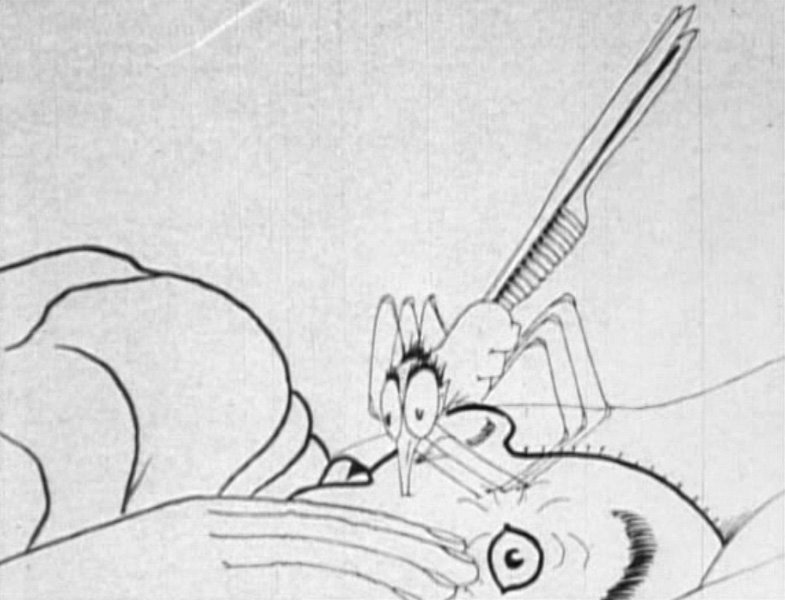
McCay cut his teeth in animation by introducing his short film Little Nemo (1911) using established characters from his newspaper comic-strip. It was his first feature and revealed he was an artist who had now conquered the fourth dimension, time. His next feature, How a Mosquito Operates (1912)  was darker intone but demonstrated his range in storytelling. " He had the ability to amaze and amuse, to astound and inspire, to surprise with his skill, and to touch emotions hideously dark, joyously light and strangely indefinable." (Beck, 14:2004).

4) How a Mosquito Operates

In 1918, McCay's artistic talents were used as propaganda in his short film The Sinking of the Lusitania. It describes the last moments of the passenger steamer The Lusitania as it is sunk by a German U-boat in 1915. It was the first time McCay used experimental work in mixed media and cel animation. It demonstrated that animation could not only be used to bring cartoon characters to life, but could depict startling realism featuring smoke, moving water and people abandoning the doomed ship. "‘The Sinking of the Lusitania’ is an astonishing film, which may be the first animated propaganda film. It’s totally unique in its drama, and, despite its propaganda, an all time masterpiece of animation. (Grob: 2010).

5) The Sinking of the Lusitania

Winsor McCay was undoubtedly an extremely versatile, imaginative and talented artist who's skills were not really appreciated until recently. The International Animated Film Society (ASIFA - Hollywood) fittingly have bestowed their highest award the Winsor McCay award. Winsor McCay was, in the words of critic W. Almont LaPeer, "the Mozart of Cartoonland."

Bibliography

Beck, Jerry (2004). Animation Art From Pencil to pixel, the histroy of Cartoon, Anime and CGI. London, Flame Tree Publishing.

Erickson, Hal. New York Times overview. 2010.
http://movies.nytimes.com/movie/151281/Gertie-the-Dinosaur/overview Accessed 10/03/11

Grob, Dr. Dr Grob's Animation review 22nd June 2010.
http://animationreview.wordpress.com/2010/06/22/the-sinking-of-the-lusitania Accessed 10/03/11

Illustrations

1) Winsor McCay http://library.osu.edu/sites/exhibits/cartoonists/images/mcCay/mccay-self.jpg Accessed 10/03/11

2) Dream of the Rarebit fiend http://http://library.osu.edu/sites/exhibits/cartoonists/images/mcCay/rarebit.jpg Accessed 10/03/11

3) Gertie The Dinosaur http://www.filmreference.com/images/sjff_01_img0194.jpg&imgrefurl Accessed 10/03/11

4) How a Mosquito Operates http://img.listal.com/image/694175/936full-how-a-mosquito-operates-screenshot.jpg Accessed 10/03/11

5) The Sinking of the Lusitania http://animationreview.files.wordpress.com/2010/06/the-sinking-of-the-lusitania-c2a9-winsor-mccay.jpg Accessed 10/03/11