Monday, 13 February 2012

Transcription - Style and Visual inspiration

After my second meeting with Alan, we established the key to making this project a success was establishing a visual style. My goal is to make an animated short that is respectful of the source material and subject matter but is also aware it is animation. The visual style I am aiming for is somewhere in between real and caricature. I've been researching sources for inspiration:

Character:


Environments:


Real life sources:


Other sources of inspiration:


Friday, 10 February 2012

Akira - World Animation Review (Japan)

Akira - 1988
Director - Katsuhiro Otomo
1. Akira Poster

Plot summary / review:
Adapted from his own manga series of the same name, Katsuhiro Otomo's "Akira" is a landmark in Japanese animation and filmmaking. A brutal alternative to the works of Disney, Otomo's feature length animation is a reflection of a culture that has survived nuclear fallout.

Set in 2019, Neo-Tokyo has risen from the ashes of World War 3. Ruled by corrupt politicians and a powerful military leader, the city is writhe with violence from underground terrorist groups to teenage biker gangs. The post-apocalyptic world they inhabit is beautifully rendered. At the time of release, Janet Maslin of the New York Times notes, "Mr. Otomo invests this dark flowering of post-nuclear civilization with a clean, mean beauty. The drawings of Neo-Tokyo by night are so intricately detailed that all the individual windows of huge skyscrapers appear distinct." (Maslin. 1990). Otomo animates separate layers of the city at different rates, simulating a camera panning across a vast environment adding depth, perspective and realism.

2. Neo-Tokyo

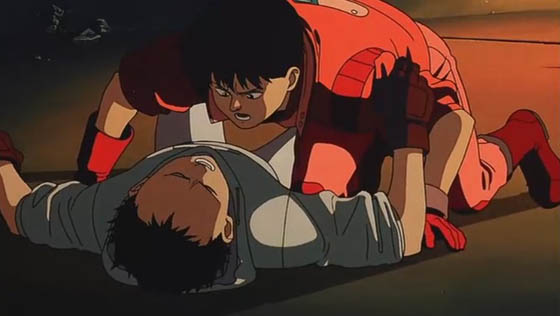
Biker gang the "Capsules", lead by Kaneda and his long term friend Tetsuo, race through the streets defending their turf from rival gang the "Clowns." A chance encounter with Takeshi (a telekinetic child with a decrepit appearance), leaves Tetsuo hospitalized and the rest of his crew in handcuffs. 

 3. Kaneda attends to the injured Tetsuo

Colonel Shikishima and irresponsible scientist Doctor Onishi discover Tetsuo has similar powers to a deity called "Akira", believed to be the cause of the nuclear fallout 31 years ago. It is revealed Shikishima and Onishi have been experimenting on children with telekinetic abilities in an attempt to harness their power. They plan to continue their research on Tetsuo, who is struggling to control his new found abilities. 

Meanwhile, Kaneda becomes embroiled with Kei, a beautiful girl involved with anti-government activists intent on uncovering the truth about Akira. Kaneda helps them infiltrate the building holding Tetsuo, Takeshi and two other psychic children Kiyoko and Masaru. Tetsuo's unstable new power, coupled with his fierce nature stemming from a life of rejection and bullying begin to take its toll. He violently escapes from his captors and rampages through the city. Pursued by the Government, terrorists, psychics and former friends, Tetsuo seeks to confront Akira, whose in cryogenic suspension beneath the new Olympic Stadium. Tetsuo unearths his remains for an epic final showdown that includes body-horror images enough to make David Cronenberg squirm.

4. Rampaging Tetsuo

Otomo's masterpiece was reversed engineered, starting with conceiving the end of the film first. His Manga series officially ended in 1990, two years after the anime release. By writing the end of the film first, Otomo was able to figure out which Manga elements would make the cut of the film without making it too lengthy.

It's running time however is still over two hours, unusual and ambitious for an animated feature. To realize Otomo's epic vision took the combined effort of numerous Japanese entertainment companies. As a result they produced realistic motion and for the first time in a Japanese anime, lip-synced dialogue. Phelim O'Neil of the Guardian newspaper states it's "Style and substance run neck and neck in this thrilling, bold landmark film that just refuses to become dated." (O'Neil. 2011).

Otomo's "Akira" raised the bar for sci-fi storytelling not only in animation, but all feature film. It also highlights many misconceived perceptions of Manga as Kim Newman of Empire magazine explains. "For anyone who thinks manga is all about incomprehensible storylines, naked girls with no pubic hair and a myriad of monsters that invariably turn into giant penises, this will set you straight." (Newman. 2008).


Bibliography

Maslin, Janet. New York Times review. 19th October 1990
http://movies.nytimes.com/movie/review?res=9C0CE1DF113CF93AA25753C1A966958260&partner=Rotten%20Tomatoes Accessed 08/02/12

Newman, Kim. Empire review. 10th March 2008
http://www.empireonline.com/reviews/reviewcomplete.asp?DVDID=7729 Accessed 08/02/12

O'Neill, Phelim. Guardian Review. 23rd June 2011
http://www.guardian.co.uk/film/2011/jun/23/akira-film-review Accessed 08/02/12

Illustrations

1. Akira Poster
http://www.impawards.com/1990/akira.html Accessed 08/02/12

2. Neo-Tokyo
http://www.gamingdaily.co.uk/2010/deus-exja-vu/ Accessed 08/02/12

3. Kaneda attends to the injured Tetsuo
http://www.madmind.de/2010/03/20/akira-review/ Accessed 08/02/12

4. Rampaging Tetsuo
http://grizzlybomb.com/2011/05/27/akira-movie-doomed/ Accessed 08/02/12

Tuesday, 7 February 2012

Transcription Pipeline

After my first transcription tutorial with Alan, we established that transcribing the BBC pathe footage may not be the best route to take. As the subject matter is personal to me and my family, we agreed I should look further into the source material that set off the idea in the first place.

So I will be transcribing my fathers novel called "Dad's Story" into an Animated Short. My pipeline will be:

PRE-PRODUCTION


  • Project start: "Dad's Story"
  • Analysis: Filter out "key scenes" into a manageable 3 act structure between 1- 3 minutes long
  • 2D animatic: outlining basic storyline / camera angles
  • Visual research: 1940's architecture (British / German), birds eye view landscapes, Avro Lancaster B52 bomber, German anti aircraft weapons, RAF uniforms, pictures of Warrant Officer Harry Lavey DFM and other family photo's
  • Concept Art: Digital paintings of key scenes / environments. Character design turnarounds and orthographic views 
PRODUCTION

  • Modelling: Avro Lancaster B52 bomber, Environments, Character
  • UV mapping / texturing: Lancaster B52 bomber, Environments, Character
  • Rigging: Lancaster and character
  • Animation: Lancaster and character
  • Effects simulation: Clouds, Lancaster engine exhaust, bullet trails
  • Lighting: Key scene lighting
  • Rendering: Beauty, ambient occlusion, Z-depth
POST PRODUCTION
  • Compositing: Combining render passes, matte painting integration
  • Final edit / sound: Editing and exporting with sound
  • AFter effects: Camera shake, bullet trails
Seeing this in black and white seems quite daunting. At this stage I'm still reading the novel and deciding on what to put in and what to leave out. I understand it may look like I'm biting off more than I can chew, but when I start to finalize the basic structure I will refine this pipeline.

Games Modelling Head Progress

Wednesday, 1 February 2012

Mary and Max - World Animation review (Australia)

Mary and Max - 2010
Director - Adam Elliot

1) Mary and Max Poster

Plot summary / review:
Australian director Adam Elliot follows up his Oscar winning short animation "Harvie Krumpet" (2004) with his first claymation feature film, "Mary and Max". Elliot's unique visual style rivals Nick Park of Aardman Animation and combines it with a dark narrative and black humour Tim Burton would be proud of. Alex Zane of The Sun newspaper notes, "while most animated movies are aimed at kids, this one deals with themes ranging from death and bullying to mental illness." (Zane. 2010). This bleak summary should not put off viewers as Zane goes on to say "this is one of the most life-affirming, feel-good movies of the year." (Zane. 2010).

In the suburbs of Melbourne, Australia; eight year old Mary Daisy Dinkle is an outcast with an active imagination. With a birthmark on her forehead "the colour of poo", her only friends are replica figurines she has made of her favourite cartoon characters "The Noblets". Her father works in a factory (connecting the strings to tea bags), a recluse who confines himself to his shed to work on his hobby, taxidermy. Her mother is a house wife of sorts, interested only in baking cakes (badly), smoking, listening to the cricket results and constantly "testing" sherry.

2. Mary Daisy Dinkle

One day Mary accompany's her mother to the local post office and spots a telephone directory for New York. Fascinated with the funny sounding names, she randomly picks one and decides to send off a letter. The recipient is middle-aged, obese introvert Max Jerry Horowitz. The pair form an unlikely bond and correspond with each other over the next 20 years, discussing practically every topic that comes to mind. In that time, Mary grows into a young woman, attends university, falls in love and gradually connects with society. Similarly, Max comes out of his shell even after he is diagnosed with "Asperger syndrome". Their friendship blossoms but isn't always necessarily plain sailing. At one point Mary's over enthusiastic nature pushes Max's trust issues to the limit.

3. Max

Elliot has expertly realised the worlds his characters inhabit. He has clearly thought out every frame of every scene and demonstrates an excellent understanding of shot framing. Similarly, he has given careful thought to the visual style, using a muted colour palette to reflect Mary and Max's unhappy existence. Mary's Melbourne is a dull range of sepia reminiscent of her birthmark, whilst Max's New York is a stark contrast of black and white. Andrew Pulver of the Guardian newspaper reiterates, stating "All of this is rendered in almost completely monochromatic claymation – only occasional colours stand out, such as the red pompom Mary sends to Max." (Pulver. 2010). This selected splash of colour serves as a beautiful metaphor of Mary and Max's companionship and the joy it brings them.

4) Monochromatic Worlds

Given a 12 certificate in the UK, the simple but brave storyline maybe lost to the younger audience, but there is enough toilet humour to keep them amused. It is also layered with throwaway gags the mature viewer will understand confirming Elliot as "a talent eccentric enough to make Nick Park look like an office drone, and the serious sadness underpinning his vision only makes the humour work better." (Robey. 2010). His detailed environments will throw up new surprises with each viewing and his subtle casting brilliantly compliments the characters they voice. This includes Toni Collette as the older Mary; Phillip Seymour Hoffman as Max; Barry Humphries (AKA Dame Edna) as the narrator and Mary's mother and Eric Bana as Mary's love interest Damian.

Andrew Pulver of the Guardian neatly summarises "Mary and Max", describing it as "a very odd, very unlikely animated film from Australia that manages to be sickly-cute, alarmingly grotesque, and right-on at the same time – often in the very same scene." (Pulver. 2010). It may not be to everyone's taste, however it has cult classic written all over it. 


Bibliography

Pulver, Andrew. The Guardian review 21st October 2010
http://www.guardian.co.uk/film/2010/oct/21/mary-and-max-review Accessed 01/02/12

Robey, Tim. Daily Telegraph review 21st October 2010
http://www.telegraph.co.uk/culture/film/filmreviews/8078477/Mary-and-Max-review.html Accessed 01/02/12

Zane, Alex. The Sun review 22nd October 2010
http://www.thesun.co.uk/sol/homepage/showbiz/sftw/3191562/Alex-Zane-reviews-Mary-And-Max.html Accessed 01/02/12

Illustrations

1. Mary and Max Poster
http://www.rowthree.com/2009/12/23/mary-max-why-has-this-been-overlooked/ Accessed 01/02/12

2. Mary
http://cutprintreview.com/reviews/4-12-stars/mary-max-review/ Accessed 01/02/12

3. Max
http://www.listal.com/viewimage/807886 Accessed 01/02/12

4. Monochromatic Worlds
http://www.thesun.co.uk/sol/homepage/showbiz/sftw/3191562/Alex-Zane-reviews-Mary-And-Max.html Accessed 01/02/12